
Senior Care After Hospital Discharge: Why the First 72 Hours Matter Most

July 21, 2026 · 9 min read
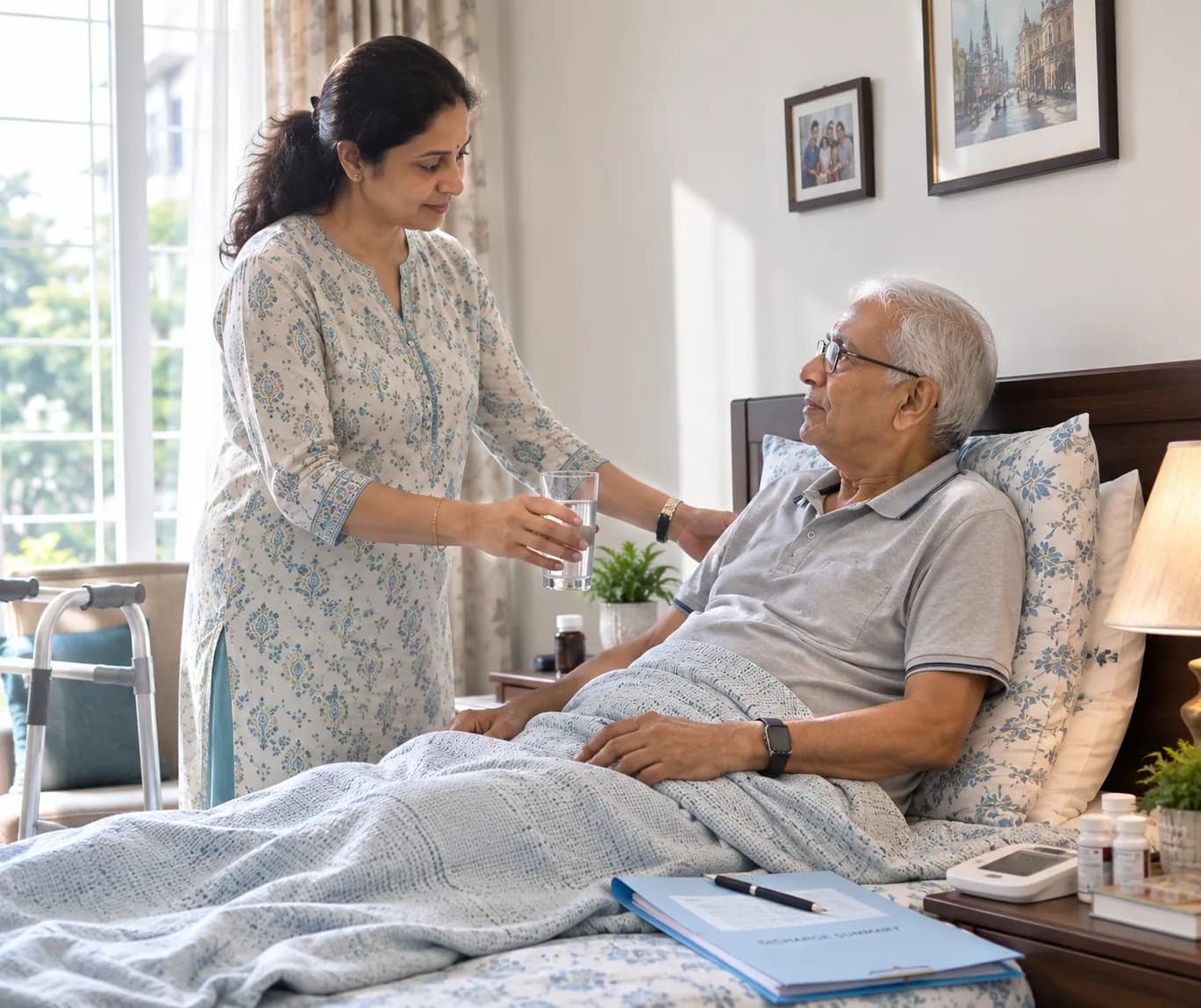
I've watched hundreds of families walk out of a hospital ward with a parent, and almost every one feels the same relief — as if the hard part is finally over. I understand it. But I'll be straight with you: bringing an elderly parent home is not the finish line. It's the start of the most fragile stretch of their recovery. The paperwork is signed, the doctors and nurses who watched over them around the clock are behind you, and suddenly all of that responsibility lands on the family.
The first 72 hours are when small oversights quietly turn into serious setbacks — a missed tablet, an unnoticed fever, a fall on the way to the bathroom. Let me walk you through exactly what those early days ask of you, so you can protect the recovery you've already worked so hard for.
Figures indicative; confirm coverage with your insurer.
"Stable enough to leave" is not the same as "safe at home"
Here's the first thing I tell every family: hospitals discharge patients when they're stable enough to leave, not when they're fully recovered. For an older adult, those two things can be worlds apart.
Think about those first days. The body is still weak from illness, surgery, or infection. New medicines have been added, sometimes replacing old ones, on an unfamiliar schedule. Appetite is poor, sleep is disturbed, and confusion — especially after anaesthesia or a long stay — is common in seniors. Studies suggest roughly a third of elderly patients hit some complication or setback in the weeks after discharge, and a good share of those begin in the very first days at home.
What worries me most is the drop in monitoring. At home, no one is checking vitals every few hours; no trained eye is watching the wound. A parent who seems fine at 6 pm can slide by midnight, and without someone who knows the warning signs, that change goes unnoticed until it's an emergency.
Here's what I want you to hold onto: discharge means medically stable, not fully recovered. The first 72 hours need active supervision, not just rest — this is exactly the window where structured recovery care keeps a parent from making a return trip to the hospital.
If you do one thing well, make it the medicines
If you get only one thing right after discharge, let it be this. Medication errors are among the most common — and most preventable — reasons older adults land back in hospital, and I've watched it happen to careful, loving families.
What "medication reconciliation" actually means
Don't let the phrase scare you. Reconciliation is just building one accurate, current medication list and making sure everyone follows it. A hospital stay scrambles a senior's routine: some medicines get stopped, some doses change, new ones get added. Families often keep giving the old home medicines and the new hospital ones — and that's how you double up: two blood-pressure tablets, two blood thinners, two painkillers.
The checklist I'd hand you
- Sit down with the discharge summary and list every medicine on it: drug, dose, timing, and how long to continue.
- Gather every medicine already at home and physically compare it against that list.
- Flag anything that shows up on both lists under different brand names — the same drug is sold as several brands in India.
- Confirm which pre-hospital medicines have been stopped, and set those aside so they aren't taken by mistake.
- Ask the discharging doctor or pharmacist directly about any tablet you're unsure of. Please don't guess.
- Note which medicines need food, and which clash with common foods or supplements.
Keep the final list written large and clear, taped where the caregiver can see it. A pill organiser loaded a week at a time takes most of the daily guesswork out of it.
The discharge-day checklist I don't let families skip
Discharge is rushed and emotional, and that's exactly when important details slip away. Before you leave the ward, make sure you have:
- The complete discharge summary and all diagnostic reports (bloods, scans, biopsy results).
- A clear medication schedule as above, plus enough supply to last until you can restock.
- The date, time, and doctor for every follow-up appointment.
- Written wound-care or catheter-care instructions, if they apply.
- A list of warning signs the doctor wants you to watch for, and a number to call.
- Any prescribed equipment arranged — walker, commode chair, hospital bed, oxygen, or a pressure-relieving mattress.
- Clarity on diet: what your parent can and cannot eat, and any fluid restrictions.
- Instructions on activity: how much they should move, and what to avoid.
And a step families forget in the rush — sort the home before your parent arrives. Clear the walkways, take up loose rugs and clutter, get the bed to a safe height, and make the path to the toilet well-lit and clear. Falls in the first week are a leading cause of readmission, and almost all are avoidable.
At home, you become the monitoring system
This surprises families most: once you're home, you are the monitoring system the hospital used to be. The good news is you don't need medical training — just a routine and an eye for what "normal" looks like for your parent.
Watching the wound
For a surgical or pressure wound, check the site daily in good light. Look for redness spreading outward, swelling, warmth, or discharge — especially if it smells or turns yellow-green. A wound that was closing but starts to open, or pain that worsens instead of easing, needs a doctor promptly. Keep dressings clean and dry, and follow the exact changing schedule you were given.
Tracking vitals
If your parent came home with a fever, diabetes, or a heart or lung condition, keep a simple daily log:
- Temperature — a fever above 100.4°F (38°C) is a warning sign, especially after surgery or infection.
- Blood pressure and pulse, if you have a monitor at home.
- Blood sugar, if diabetic — illness and new medicines can swing readings sharply.
- Oxygen saturation with a pulse oximeter, for anyone with respiratory or cardiac issues.
- Fluid intake, urine output, and bowel movements — constipation and dehydration are common and easily missed.
Write the numbers down with the time. I promise you, a written trend tells a doctor far more than "he seemed a bit off today."
Please don't skip the follow-ups
Follow-up visits aren't formalities. They're where a doctor catches a slow infection, adjusts a dose that's causing dizziness, or takes out stitches before they cause trouble. Missed follow-ups are strongly linked to readmission — yet they're the easiest thing to skip when a parent is weak, transport is hard, or the family assumes recovery is going fine.
So book the appointments before you leave the hospital, arrange transport in advance, and carry the full file — discharge summary, reports, and your medication and vitals logs — to every visit. If your parent is too frail to travel, ask whether a home visit or teleconsultation is possible. There's almost always a way.
Home care or a supervised stay — deciding honestly
Not every family is set up to manage those first days safely, and I'll say it plainly: there's no shame in admitting that. Being honest about whether you can cover this window is itself an act of good care.
When home may be enough
Home works well when the recovery is straightforward, at least one capable family member can be present around the clock, the home is safe and accessible, and you can reliably manage medicines, wound care, and appointments. A visiting nurse or physiotherapist can fill the smaller gaps.
When I'd nudge you toward supervised care
I'd gently suggest a short recovery stay in a professional care home when:
- Your parent had major surgery, a serious infection, a stroke, or needs intensive post-surgery rehabilitation.
- Wound care, injections, catheters, or feeding support are involved.
- There's a real fall risk, or your parent needs help moving, bathing, or using the toilet.
- The primary caregiver works full-time, lives far away, or is an NRI managing from abroad.
- The home can't easily be made safe, or there's simply no one there at night.
A supervised recovery stay puts trained nurses, physiotherapists, and doctor oversight around your parent exactly when the risk is highest — with medication management, wound care, monitored vitals, nourishing meals, and structured rehabilitation and post-surgery care under one roof. For many families, a two- to four-week stay bridges that dangerous gap between hospital and full independence. Honestly, learning to prevent hospital readmission often comes down to this one decision.
A straight word on insurance and cost
Recovery care is more affordable than most families assume, and often partly covered. Many health insurance policies in India — and government schemes such as PM-JAY — include a limited post-hospitalization period, commonly up to around 15 days, that may cover certain follow-up care, medicines, and diagnostics. Coverage varies a lot by policy, so please confirm the exact terms with your insurer before assuming anything.
As a rough 2026 ballpark, a supervised recovery or rehab stay in India runs about ₹1,000–₹5,000 per day, or roughly ₹40,000–₹1,50,000 per month, depending on the level of nursing and the city. Weigh that against the cost — financial and emotional — of a preventable readmission, and a short recovery stay often turns out to be the wiser spend.
Frequently asked questions
How long does an elderly person need close supervision after discharge?
It depends on why they were admitted, but the first 72 hours are the most critical, and close supervision is usually needed for at least the first two weeks. After major surgery or serious illness, I'd plan for structured support of a month or more until your parent regains strength and mobility.
What are the most common reasons seniors get readmitted?
Medication errors, infections (of wounds, lungs, or urinary tract), falls, dehydration and poor nutrition, and missed follow-up appointments. Almost all of these are preventable with attentive care in the early recovery period.
Can we manage post-discharge care at home ourselves?
Many families can, especially for straightforward recoveries, with a visiting nurse or physiotherapist. The honest questions are whether someone can be present day and night, whether the home is safe, and whether you can confidently manage medicines and wound care. If any answer is no, a short supervised stay is safer.
Does insurance cover care after hospital discharge?
Many policies and PM-JAY include a limited post-hospitalization window — often up to about 15 days — that may cover follow-up medicines, diagnostics, and certain care. The details vary greatly, so confirm your specific coverage with your insurer.
When should I call a doctor during recovery?
Call promptly for fever above 100.4°F, a wound that's increasingly red, swollen, or discharging, sudden confusion, breathing difficulty, chest pain, uncontrolled pain, repeated vomiting, no urine output, or any fall. When in doubt, it's always better to ask.
Let me help you through the first days
The days right after discharge are hard, and you really don't have to face them alone. At Prarambh Care Homes, our trained nurses and physiotherapists provide doctor-led recovery care with medication management, wound care, monitored vitals, and nourishing meals — the very support that keeps a fragile recovery on track. I've walked more than 350 families through this exact transition at our Noida and Ahmedabad homes.
If your parent is coming home soon and you're unsure how to manage those first weeks, book a visit or call me at +91 95120 21118. Let me help you turn a stressful discharge into a safe, steady recovery.
Medical Reviewer — Emergency & General Medicine, MBBS
MBBS physician with over two decades in emergency, critical and general medicine. Read full profile →
Bring the right care to your family
Get a compassionate, doctor-led care plan from our Noida & Ahmedabad team.