
Assisted Living, Nursing Home or Old Age Home? Understanding the Difference in India

July 3, 2026 · 8 min read
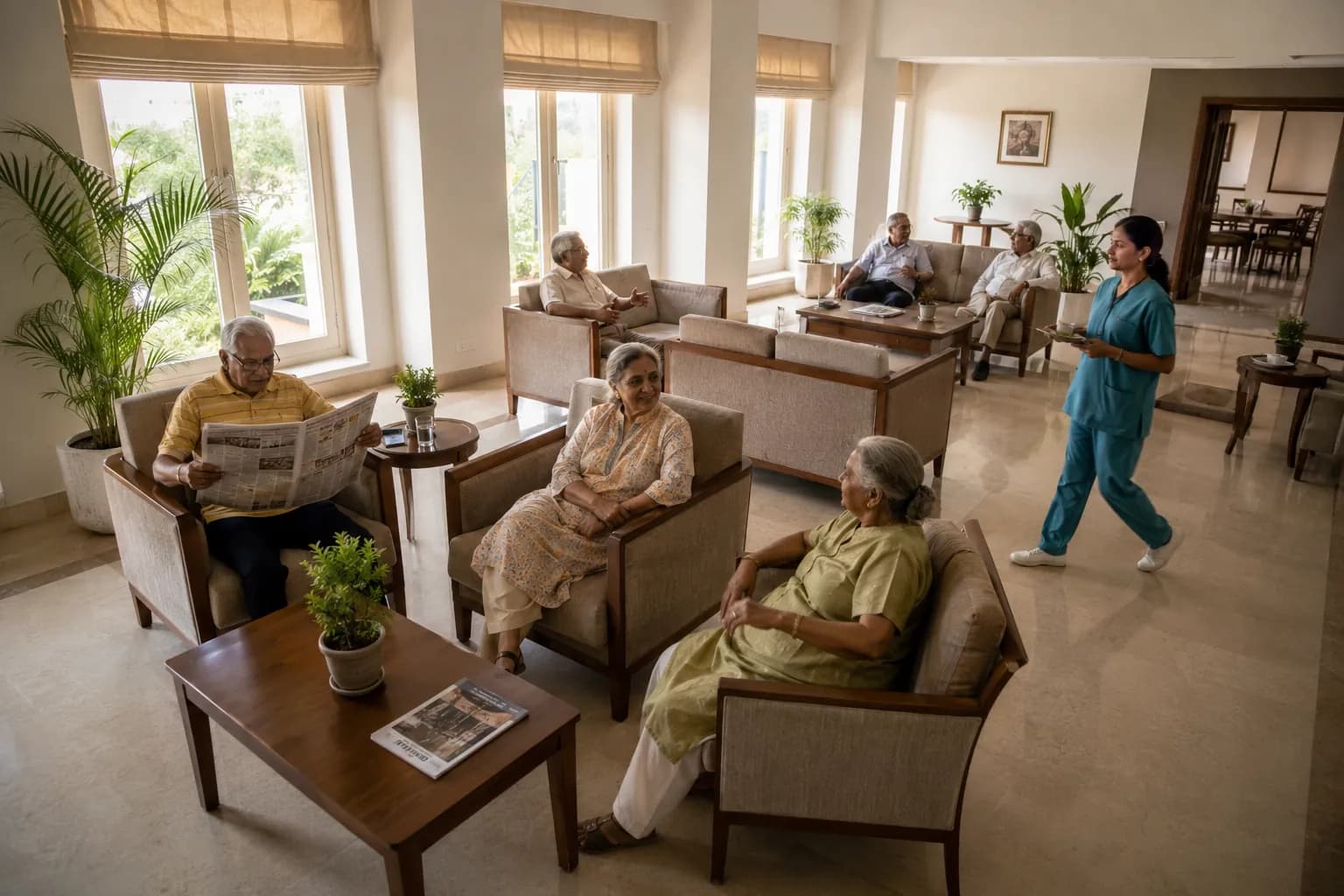
I get asked this in nearly every first conversation with a worried family, and I don't blame anyone for being confused. "Assisted living," "nursing home," "old age home," "memory care" — in India these words get used interchangeably, and they mean very different things. Choose the wrong one and you either pay for care your parent doesn't need, or worse, settle for a place that can't meet their medical needs.
So let me untangle the terms the way I do across the table from a family — plainly, with Indian context, so you can match your parent's real needs to the right kind of home.
Sources: Govt. of India / UNFPA population projections; 2026 market ranges.
It all comes down to the level of care
Every type of senior care home sits somewhere on a scale, from "a little help with daily life" to "round-the-clock medical supervision." Working out where your parent falls on that scale is the single most useful thing you can do before you visit a single facility. And with around 150 million Indians now aged 60 and over — a number set to more than double by 2050 — this is a decision more families face every year.
When a family sits down with me, I ask three simple questions:
- Can they manage most daily tasks — bathing, dressing, eating, moving around — with a little help, or do they need hands-on assistance for most of them?
- Do they have ongoing medical needs — wounds, feeding tubes, oxygen, unstable diabetes, post-stroke care — that need a nurse or doctor daily?
- Is memory loss (dementia or Alzheimer's) part of the picture, with wandering, confusion or agitation?
Your answers point straight to one of the four options below.
Assisted living: help with daily life, not a hospital
Assisted living is for seniors who are largely independent but need a hand with some activities of daily living — and who benefit from safety, company and structure. Picture a parent who can walk and talk and enjoy their day, but who's unsteady on their feet, forgets their medicines, or shouldn't be alone at night.
A good assisted living home in India typically offers help with bathing, dressing and mobility on the resident's own schedule, medication management, three nutritious meals, housekeeping and laundry, on-site nursing with visiting doctors, and physiotherapy, activities and social life to keep spirits up. The philosophy — and this is the part I care about most — is dignity and independence with a safety net. Residents keep as much control over their lives as possible. It's the right fit for a large share of families, and it's the model behind our own assisted living care.
Here's what I tell families: assisted living is not a hospital, and it is not "giving up." It's help with daily life so your parent can stay safe, social and as independent as possible.
Nursing (high-dependency) care: when the needs are clinical
A nursing home — sometimes called high-dependency or long-term nursing care — is for seniors with significant, ongoing medical needs that require trained nurses around the clock. This is a real step up in clinical intensity from assisted living.
In my experience it suits residents who are bedridden or largely immobile and need help with turning and pressure-sore prevention, are recovering from a stroke, fracture or surgery, are managing feeding tubes, catheters, oxygen or complex wounds, or are living with several unstable chronic conditions. Here the emphasis shifts from lifestyle to clinical stability and comfort — higher staffing ratios, nurses present 24/7, doctors reviewing residents more often. Many families move a parent here straight after a hospital stay; our guide on senior care after hospital discharge explains that transition.
Memory care: built around dementia
Memory care is a specialised environment for seniors living with dementia or Alzheimer's. It looks like assisted living in places, but it's purpose-built around the safety and dignity of someone whose memory and judgement are impaired.
The differences that genuinely matter are a secure, wander-safe layout so residents can't leave unsupervised or get lost, staff trained specifically in dementia communication and de-escalation, structured routines and calm design that reduce agitation, and higher supervision to manage confusion and sundowning safely. I'll be blunt here: if memory loss is the main challenge, general assisted living usually isn't enough. We compare the two properly in memory care vs assisted living, and our dementia and Alzheimer's care is designed for exactly these needs.
And what about "old age homes"?
In everyday Indian usage, "old age home" is a broad, informal term that can mean almost anything — from a charitable shelter for seniors with no family, to a paid retirement residence, to a basic care facility. Historically many focused on shelter and companionship rather than professional, medically-supervised care.
That's exactly why I tell families the label tells you very little about the actual services. Two places both calling themselves "old age homes" can be worlds apart in staffing, hygiene and medical support. So don't choose on the name — choose on what care is actually delivered. Our 20-question checklist helps you look past the label.
Side by side
| Feature | Assisted Living | Nursing / Memory Care |
|---|---|---|
| Best for | Mostly independent seniors needing daily help | High medical needs or dementia |
| Medical support | On-site nurses, visiting doctors | 24/7 nurses; specialist / secure setup |
| Daily-life help | Bathing, meds, meals, mobility | Full assistance; clinical care |
| Feel of the place | Home-like, social, independent | Clinical (nursing) or secure (memory) |
| Typical cost/month | ~₹40,000–₹1,50,000 | ~₹50,000–₹2,50,000 |
Those costs are approximate India-wide ranges for 2026 and vary a lot by city, room type and care level — Ahmedabad tends to be lower than Noida and Delhi NCR. For a full breakdown, see our cost of senior care in India guide, and always ask a specific home for an exact quote.
Typical monthly cost by care type (India, 2026)
Approximate; lower in Ahmedabad than Noida/Delhi NCR.
How I'd actually decide
You don't have to figure this out alone, and you don't have to get it perfect on day one. A few pointers I give every family:
Start with a proper assessment. A good care home will assess your parent's physical, medical and cognitive needs before recommending a care level — not just push the most expensive option. If a place quotes a price before understanding your parent, be cautious.
Match care to needs, not fears. It's tempting to over-provide "just in case," but placing an active, social parent in a clinical nursing setting can be isolating. Equally, don't under-provide — an assisted living home cannot safely manage advanced dementia.
Plan for change. Needs evolve. A home that offers several care levels on one campus means your parent can transition without the trauma of moving somewhere entirely new.
Visit in person. Nothing replaces walking in, smelling the air, watching how staff speak to residents, and seeing a real mealtime. Browse our care homes and come see for yourself.
Here's the rough rule of thumb I leave families with:
- Needs help with some daily tasks but is medically stable → assisted living
- Serious, ongoing medical needs or bedridden → nursing care
- Living with dementia, wandering or confusion → memory care
- Just needs companionship and a safe roof → look closely; a well-run assisted living home usually serves better than a basic old age home
Frequently asked questions
Is assisted living the same as a nursing home in India?
No. Assisted living helps mostly-independent seniors with daily tasks like bathing, meals and medicines in a home-like setting. A nursing home provides intensive, 24/7 clinical care for serious medical needs. Assisted living has a safety net of nurses and doctors, but it isn't a hospital-level environment.
Can a person move from assisted living to nursing care later?
Yes, and it's common as needs change. The best homes offer several care levels so a resident can step up (or down) in support without moving somewhere unfamiliar. Ask any facility how they handle changing needs before you commit.
Which is cheaper — assisted living or a nursing home?
Assisted living is generally more affordable because it involves less intensive clinical staffing. Nursing and memory care cost more due to higher staff ratios and specialist infrastructure. Costs also vary by city — Ahmedabad is usually lower than Noida and Delhi NCR.
My parent has early dementia but is physically fine. What do they need?
Physical fitness with memory loss usually points to memory care rather than general assisted living, because the priority is a secure, wander-safe environment and dementia-trained staff. See memory care vs assisted living for how to judge the right time.
How do I know if an "old age home" is actually good?
Look past the name at the substance: staff qualifications and ratios, medical support, hygiene, food, safety systems and transparency. Our 20-question checklist walks you through exactly what to inspect.
Come and see the difference
Choosing the right kind of care is one of the most loving decisions a family can make — and you deserve honest guidance, not a hard sell. At Prarambh Care Homes in Noida and Ahmedabad, we'll assess your parent's real needs, explain the options plainly, and match them to the right level of care — from assisted living to specialist memory and nursing support, with 24/7 doctor and nurse-led teams trusted by 350+ families.
Book a visit to walk our homes and meet the team, or call me on +91 95120 21118. I'm here to help you decide with confidence and kindness.
Medical Reviewer — Emergency & General Medicine, MBBS
MBBS physician with over two decades in emergency, critical and general medicine. Read full profile →
Bring the right care to your family
Get a compassionate, doctor-led care plan from our Noida & Ahmedabad team.