
How Much Does Senior Care Cost in India? Assisted Living, Dementia & Nursing Care (2026)

July 7, 2026 · 9 min read
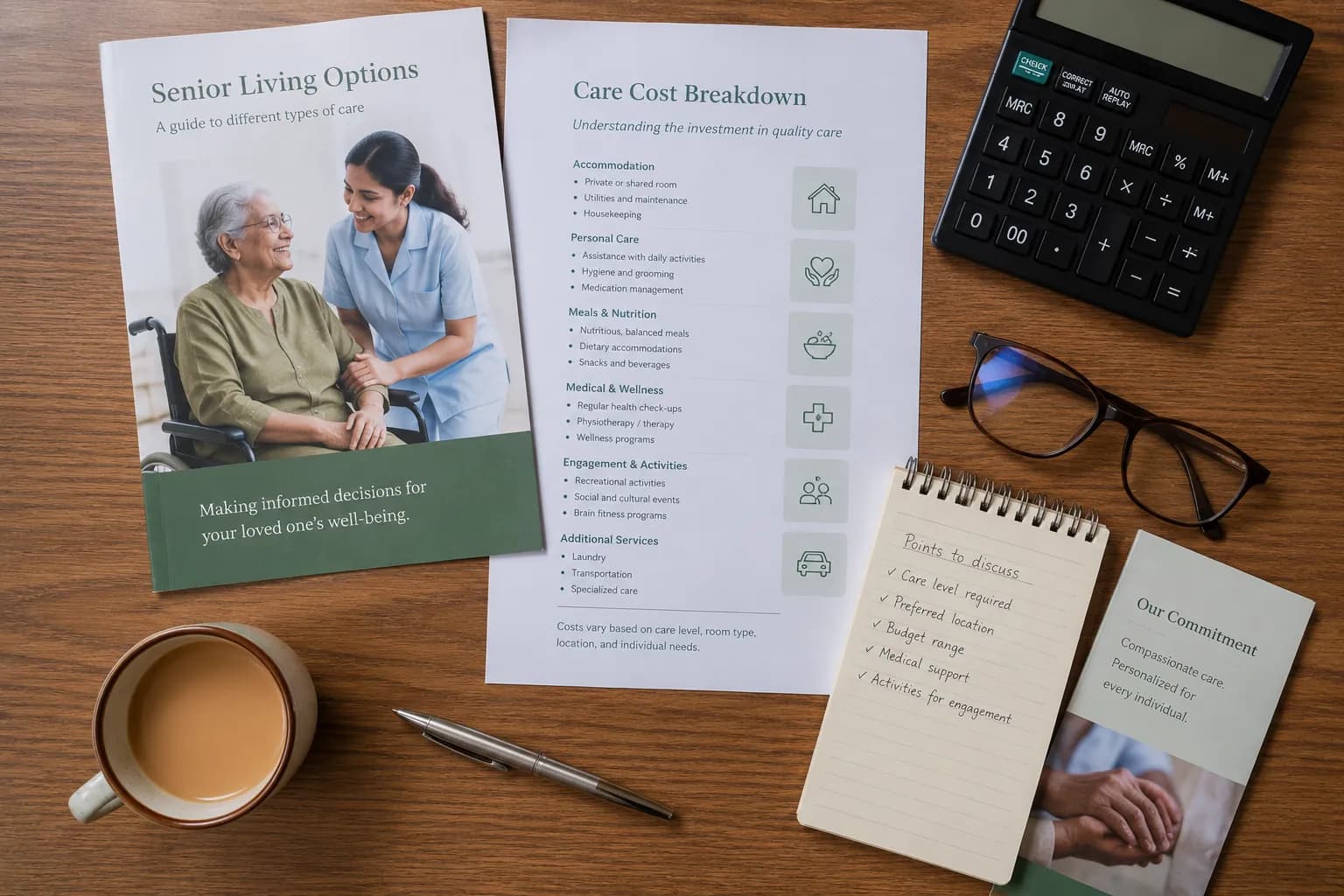
Let me be honest about the question families really want answered first — but often feel too polite to lead with: how much is this going to cost? I've sat across from enough worried sons and daughters to know that the price is where the anxiety lives, and I don't blame anyone. Senior care pricing in India can feel deliberately foggy, with wide ranges and quiet extras that make planning almost impossible. With around 150 million Indians now aged 60 and older (Govt of India / UNFPA projections), more families are asking me this every year — so let me answer it the way I wish someone had answered it for you: plainly, with real numbers, and no games.
One thing before the figures. Every range below is an approximate, India-wide ballpark as of 2026. Actual costs swing a lot by city, care level, room type and the individual home. Treat these as a starting point for a conversation, then make any home you're serious about put an exact, written quote in your hands.
Sources: Govt. of India / UNFPA population projections; 2026 market ranges.
What you're actually paying for, by type of care
Here's the simplest truth I can give you: price follows how much support your parent needs. More hands-on help and more clinical supervision mean more trained staff, and staff is what you're really paying for. That's it. Everything else is detail.
| Type of care | Typical monthly range (2026) |
|---|---|
| Assisted living | ~₹40,000 – ₹1,50,000 |
| Dementia / memory care | ~₹50,000 – ₹2,00,000 |
| Nursing / high-dependency care | ~₹60,000 – ₹2,50,000 |
For short stays, respite or recovery care is usually charged per day — typically ~₹1,500–₹5,000/day depending on care level and city. I often suggest this after a hospital stay, or when a family caregiver is running on empty and needs a real break. There's more in our respite care guide.
And if you're still working out which care type your parent actually needs before you look at price — which is the right order to do it in — start with our guide on the difference between assisted living and nursing homes.
Typical monthly cost by care type (India, 2026)
Approximate; lower in Ahmedabad than Noida/Delhi NCR.
What that monthly fee should actually cover
A home that's being straight with you will tell you plainly what the headline number includes. In most well-run Indian assisted living homes, the base fee typically covers:
- Accommodation (shared or private room) and utilities
- Three meals plus snacks, adjusted for health conditions
- Help with daily activities — bathing, dressing, grooming, mobility
- Medication management and reminders
- On-site nursing support and routine doctor visits
- Housekeeping, laundry and a secure environment
- Basic activities, social events and general wellbeing programmes
Where budgets quietly slip — the extras
This is the part I want you to read twice, because it's where families get caught out. Ask specifically about every one of these, because they're often not in the base fee:
- Security deposit — a refundable amount, commonly one to three months' fee, taken at admission
- Consumables — adult diapers, wipes, protein supplements and similar personal items
- Specialist doctor visits — a visiting cardiologist, neurologist or psychiatrist, beyond the in-house physician
- Physiotherapy — sometimes included, sometimes charged per session
- Diagnostics and medicines — lab tests, scans and prescription drugs
- Private room upgrade — a single room costs more than a shared one
- Ambulance and hospitalisation — transport and any hospital bills are usually separate
- One-to-one attendant — a dedicated 24/7 attendant for a high-need resident adds cost
Here's what I tell families: the lowest headline price is almost never the true cost. A slightly higher all-inclusive fee is often cheaper — and far less stressful — than a low base fee stacked with a long list of extras you only discover on the first bill.
What actually moves the price up or down
Three things move the number more than anything else. Understand these and you'll never be surprised by a quote.
1. City and location
Metro cities and premium neighbourhoods cost more — that's real estate and staff wages talking. Noida and Delhi NCR (Gurugram, Ghaziabad, Greater Noida, Delhi) sit at the higher end. Ahmedabad is typically more affordable for a comparable standard of care. I mention this a lot to families who are flexible on city — including NRIs choosing a base city for a parent — because it can genuinely change what your budget buys.
2. Level of care
As you saw above, the more assistance and clinical supervision your parent needs, the higher the cost. A mobile, independent resident in assisted living pays far less than a bedridden resident needing 24/7 nursing, or a dementia resident needing secure, specialist care.
3. Room type and amenities
A private room costs more than a shared one. Newer homes with physiotherapy suites, richer activity programmes, better food and higher staff ratios command a premium — but I'll be honest, that premium often buys genuinely better days, and that's worth something.
Noida / Delhi NCR vs Ahmedabad: a quick comparison
| Noida / Delhi NCR | Ahmedabad | |
|---|---|---|
| General price level | Higher | More affordable |
| Assisted living (indicative) | Upper part of the range | Lower to middle of the range |
| Why | Metro real estate & wages | Lower cost base |
Both our Noida care home and Ahmedabad care home deliver the same standard of doctor and nurse-led care — so you can choose the city that suits your family and your budget without trading down on the actual care. Explore both from our care homes hub.
The budgeting advice I give every family
Planning ahead makes this whole thing lighter — financially and emotionally. Here's what I'd tell you over a cup of tea:
- Ask for an all-in monthly estimate, not just the base fee — and get it in writing, listing what is and isn't included.
- Budget a 15–20% buffer for consumables, medicines and the occasional specialist visit.
- Clarify the deposit and refund policy up front — how much, and exactly when you get it back.
- Confirm how care-level changes affect price. If your parent's needs increase, will the fee change, and by how much?
- Consider a shared room. Many seniors are honestly happier with the companionship, and the savings are real.
- Pool family contributions. For NRI families especially, siblings sharing the cost makes premium care very manageable.
- Weigh the true cost of home care. A full-time attendant, plus a family member's time, the safety risks and the medical emergencies, often costs more — in money and in stress — than a professional home.
What about insurance and government schemes?
I get this question a lot, and I'd rather set the expectation honestly now than have you disappointed later. In India, standard health insurance generally covers hospitalisation, not the day-to-day cost of long-term residential senior care. So the monthly care-home fee is usually paid out of pocket.
Ayushman Bharat (PM-JAY) and similar government schemes are aimed at hospital treatment for eligible families, not routine assisted-living charges. If your parent is hospitalised from within a care home, those hospital costs may be claimable through their existing insurance or scheme — but the residential care fee itself typically is not. Always check the fine print of your parent's specific policy, and ask the care home which of its medical services can be routed through insurance.
Frequently asked questions
What is the average assisted living cost in India in 2026?
As a broad ballpark, assisted living runs roughly ₹40,000 to ₹1,50,000 per month in 2026, depending heavily on city, room type and care level. Ahmedabad tends toward the lower end, while Noida and Delhi NCR are higher. Ask a specific home for an exact quote based on your parent's needs.
Why is dementia and nursing care more expensive than assisted living?
Because they need more. Memory care requires a secure environment and dementia-trained staff, while nursing care needs 24/7 qualified nurses and higher staff-to-resident ratios. Those higher staffing and infrastructure costs push monthly fees up compared with general assisted living.
Are diapers, physiotherapy and doctor visits included in the fee?
It varies by home, so always ask. Personal consumables like diapers are usually extra. Physiotherapy and specialist doctor visits may be included or charged separately. A transparent home will give you a clear written list of what's covered and what costs more.
Is senior care cheaper in Ahmedabad than in Noida or Delhi NCR?
Generally, yes. Ahmedabad's lower real estate and wage costs make comparable care more affordable than in Noida and Delhi NCR. Families flexible on city — including many NRIs — can get excellent care at a lower monthly cost in Ahmedabad.
Does health insurance or PM-JAY cover senior care home fees?
Usually not for the routine monthly residential fee. Health insurance and schemes like PM-JAY are geared toward hospitalisation, not long-term assisted-living charges. If your parent is hospitalised, those hospital costs may be claimable. Check your specific policy and ask the home for details.
Let me give you a clear, honest number
You shouldn't have to guess what care will cost — and you shouldn't have to decode a fee schedule to protect your parent. At Prarambh Care Homes in Noida and Ahmedabad, I believe in transparent, all-in care plans with no hidden surprises, so you can plan with confidence. Trusted by 350+ families, our teams will assess your parent's needs and put a clear, written estimate in your hands.
Book a visit or call me at +91 95120 21118 for a personalised quote and a warm, no-pressure conversation about what's genuinely right for your family.
Medical Reviewer — Emergency & General Medicine, MBBS
MBBS physician with over two decades in emergency, critical and general medicine. Read full profile →
Bring the right care to your family
Get a compassionate, doctor-led care plan from our Noida & Ahmedabad team.